Get exclusive offers, new product updates & helpful resources straight to your inbox.
By subscribing, you agree to our Privacy Policy and consent to receive updates from our company.
Eco-Friendly Takeaway Containers: Australia Guide 2026
Latest News & Updates
Eco-Friendly Takeaway Containers: The Australian Guide to Compostable Food Packaging
12 June 2026
If you run a cafe, food truck, or restaurant anywhere in Australia, eco-friendly takeaway containers have moved from a nice-to-have to a regulatory requirement. South Australia led the charge years ago, but by 2026 every mainland state has either enacted or is actively phasing in bans on single-use plastics, including the expanded polystyrene boxes and plastic-lined containers that most food businesses relied on for decades. The pressure is real, the timelines are tight, and the penalties for non-compliance are climbing.
But compliance is only part of the picture. Switching to compostable or biodegradable packaging without understanding the differences between materials, certifications, and composting infrastructure can leave you spending more than you need to, or worse, making claims to customers that do not hold up to scrutiny. Not all "eco" containers are created equal, and some products marketed as biodegradable will sit in landfill for decades just like conventional plastic.
This guide cuts through the noise. I will explain what the key terms actually mean, compare the main material types available in Australia, walk through the certifications that matter, and help you match the right container to the right food application. Whether you are sourcing for a busy poke bowl shop or a high-volume catering operation, the goal is the same: make an informed decision that keeps you compliant, keeps your food intact, and does not blow your packaging budget.
Key Takeaways
Australian state plastic bans now cover most single-use food containers, making the switch to compostable packaging a compliance issue, not just a values one.
"Biodegradable", "compostable", and "recyclable" have distinct legal and scientific meanings. Conflating them can expose your business to ACCC scrutiny under consumer protection law.
Sugarcane bagasse is the most versatile compostable container material for hot, wet, and oily foods. PLA-lined paper performs well for dry and moderate-heat applications.
Look for the Australasian Bioplastics Association (ABA) Seedling logo and compliance with AS 4736 (commercial compost) or AS 5810 (home compost) before buying certified compostable packaging.
Compostable packaging costs 10-40% more than conventional plastic per unit, but bulk purchasing, range consolidation, and the avoided cost of non-compliance narrow that gap significantly.
Composting infrastructure in Australia is still patchy. Certified compostable packaging in general waste bins goes to landfill. Communicate clearly with customers about disposal.
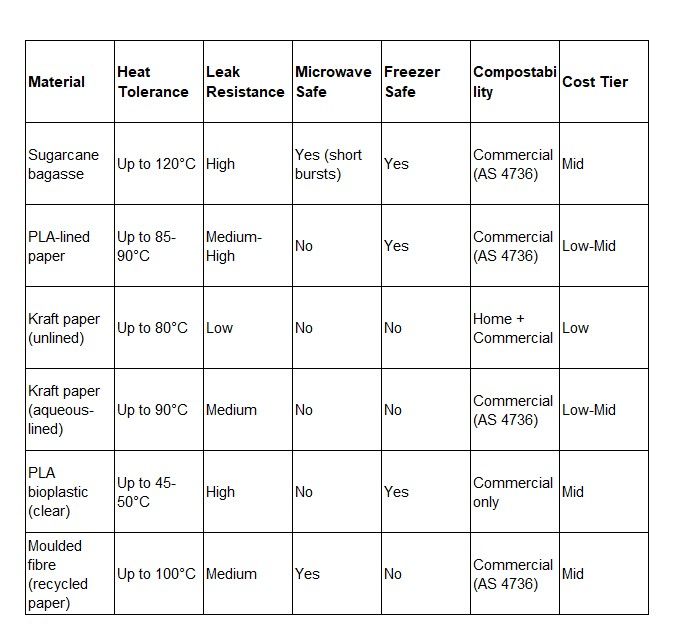
Material Comparison: Eco-Friendly Takeaway Container Options
———————————————
What 'Eco-Friendly' Actually Means: Biodegradable vs Compostable vs Recyclable
These three words appear constantly on packaging, menus, and supplier catalogues, and they are used interchangeably so often that most people assume they mean the same thing. They do not, and understanding the differences protects your business from making misleading claims to customers.
Biodegradable
Biodegradable simply means a material will break down through biological processes at some point. That definition is almost useless on its own because it sets no timeframe and no end conditions. Conventional plastic is technically biodegradable over hundreds of years. Some products labelled biodegradable contain additives called oxo-degradants that cause plastic to fragment into microplastics rather than break down into harmless organic matter. The ACCC has flagged misleading environmental claims as an active enforcement priority, and vague biodegradable marketing on packaging is exactly the kind of claim that attracts attention. If a supplier sells you something described only as biodegradable with no certification or standard referenced, ask harder questions.
Compostable
Compostable has a precise scientific meaning: a material breaks down into carbon dioxide, water, inorganic compounds, and biomass at a rate consistent with other organic material, leaving no toxic residue. In Australia, this is governed by two standards. AS 4736 covers industrial or commercial composting, which requires specific temperature, moisture, and turning conditions found in commercial composting facilities. AS 5810 covers home composting, which operates at lower temperatures over longer periods. A product certified to AS 5810 will compost in a backyard bin. A product certified only to AS 4736 requires a commercial facility and will not meaningfully break down in a home compost system or in landfill.
This distinction matters enormously when you are making claims to customers. If you are telling diners that your containers are compostable, you should also be telling them where to send them, because without access to a commercial composting facility, that claim has no practical value for most Australians.
Recyclable
Food-soiled packaging is generally not recyclable through kerbside recycling in Australia, regardless of what the material is. Most paper and cardboard contaminated with grease or food residue is rejected at Materials Recovery Facilities. Plastic containers must be clean and dry to be accepted. If you are promoting your containers as recyclable, the food contact reality means most of them will end up in landfill via the recycling stream anyway. This is not a reason to avoid recyclable materials, but it is a reason to be precise in how you communicate their end-of-life pathway.
The Honest Caveat
Even genuinely certified compostable packaging has limitations in the Australian context. Access to commercial composting for food businesses and consumers varies significantly by state, by council, and even by suburb. A beautifully certified sugarcane bowl dropped into a general waste bin in a suburb without an organics collection service ends up in landfill, where anaerobic conditions prevent meaningful composting. The infrastructure is improving, but it is not there yet across the whole country. The honest position for food businesses is to use certified compostable packaging and to actively communicate the correct disposal route, rather than implying the packaging is automatically good for the environment regardless of where it ends up.
———————————————
Sugarcane Bagasse vs PLA vs Paper: Which Material Suits Your Business?
The three dominant material categories in the Australian compostable takeaway container market are sugarcane bagasse, PLA-lined or aqueous-lined paper, and clear PLA bioplastic. Each has a distinct performance profile, and the right choice depends on your food type, service model, and customer communication approach.
Sugarcane Bagasse
Bagasse is the fibrous pulp left over after sugarcane stalks are pressed for juice. It is a genuine agricultural by-product with no additional land clearing required for its production. Moulded into containers, it produces a sturdy, slightly textured product that handles hot, wet, and oily foods better than almost any other compostable alternative.
Sugarcane bagasse containers tolerate temperatures up to around 120°C, which means they are safe to use with soups, curries, stews, and fried foods straight out of the fryer. They can go in a microwave for short reheating bursts, and most moulded bagasse containers are freezer safe, making them practical for meal prep businesses and caterers who need a container that survives the whole food lifecycle from prep to consumer reheating.
The sugarcane bagasse containers available from Food Packaging Online cover a wide range of formats, from shallow trays for grills and salads through to deeper containers suitable for rice dishes and pasta. For poke bowl shops specifically, the sugarcane poke bowls with lids are a natural fit, combining the heat and moisture resistance of bagasse with a format customers already recognise.
On the compostability front, bagasse containers certified to AS 4736 will break down in commercial composting facilities within the standard timeframe. Some manufacturers are also achieving AS 5810 certification for home compost, though this is less common. Bagasse sits in the mid cost tier, generally more expensive per unit than unlined paper but comparable to or slightly above PLA-lined board.
PLA-Lined Paper Containers
PLA stands for polylactic acid, a bioplastic derived most commonly from corn starch or sugarcane. In paper container applications, PLA is applied as a thin lining that provides moisture and grease resistance. The paper structure gives the container its rigidity, and the PLA lining prevents liquids from soaking through.
PLA-lined paper containers perform well for moderate-heat and moderate-moisture applications. The upper heat tolerance of around 85-90°C makes them suitable for warm foods but not ideal for very hot soups or direct oven use. They are not microwave safe because the PLA lining can distort at microwave temperatures. Freezer performance is generally good.
The critical issue with PLA-lined paper is composting. PLA requires industrial composting conditions with temperatures above 55-60°C sustained over several weeks to break down properly. Under home composting conditions, PLA-lined containers will not fully degrade within a standard composting cycle. For certification purposes, look for AS 4736 on PLA-lined products and be transparent with customers about the commercial facility requirement.
Aqueous-lined paper is a variant worth knowing about. Instead of a PLA coating, an aqueous (water-based) dispersion is applied to the paper surface. Some formulations achieve better home compostability performance than PLA linings, though they offer slightly lower grease resistance. For lightly oily foods or bakery items, aqueous-lined containers can be a good middle ground.
For certified compostable paper container options, the certified compostable paper containers range covers standard food service sizes with verified certification credentials.
Clear PLA Bioplastic
Clear PLA containers are the ones that look and feel almost like conventional clear plastic. They are popular for cold food display, salad bars, and deli applications where food visibility matters. Their performance profile is almost the opposite of bagasse: excellent cold resistance, low heat tolerance (around 45-50°C before deforming), and no microwave compatibility.
PLA bioplastic requires commercial composting facilities to break down effectively and is one of the more infrastructure-dependent packaging materials. It can also create confusion for consumers and waste facility operators, as PLA and conventional PET plastic often look very similar. If PLA enters the recycling stream, it can contaminate recyclable materials, while PET mistakenly sent to composting facilities creates a similar challenge. This remains a recognised issue across the packaging industry and is worth considering as part of your customer communication strategy.
By comparison, PET plastic is widely accepted through Australian kerbside recycling programs and is 100% recyclable, allowing it to be collected, processed and remanufactured into new products. This established recycling infrastructure helps support a more circular, closed-loop approach to packaging recovery and reuse.
For businesses with a genuinely cold application, clear PLA can be a credible compostable option where commercial composting facilities are available. However, for hot or warm food applications, alternative materials are generally more suitable.
Kraft Paper (Unlined)
Unlined kraft paper containers and boxes are the cheapest compostable option and have the broadest home composting applicability because there is no synthetic or bioplastic lining to break down. Their limitation is obvious: they are not moisture or grease resistant. For dry goods, bakery items, and light wrapping applications, unlined kraft works well. For anything saucy, wet, or oily, it is not a practical choice.
———————————————
Certifications That Matter in Australia
The certification landscape is one area where supplier claims and actual compliance diverge most often. Here is what to look for and what to ask.
AS 4736: Industrial Compostable
This is the Australian Standard for packaging designed to break down in industrial composting conditions. Certified products must disintegrate to no more than 10% of the original material by dry weight within 12 weeks, achieve 90% biodegradation within 180 days, and leave no toxic residue. Products certified to AS 4736 are appropriate for commercial compost streams. They will not break down meaningfully in home compost or in landfill.
AS 5810: Home Compostable
This standard applies to packaging intended to break down in home composting systems, which operate at lower temperatures (typically 20-40°C) over longer periods. AS 5810 certification is significantly harder to achieve and is less common in the market. It is the most practically useful certification for food businesses whose customers are likely to compost at home, particularly in areas without commercial organics collection.
The ABA Seedling Logo
The Australasian Bioplastics Association (ABA) administers a certification and logo programme in Australia and New Zealand. Products carrying the ABA Seedling logo have been independently assessed against the relevant Australian Standard. For buyers, the Seedling logo is a practical shortcut that tells you the certification claim has been verified rather than self-declared by the manufacturer. When evaluating suppliers, ask whether their products carry the ABA Seedling logo rather than simply accepting claims of "compostable" or "meets AS 4736" at face value.
EN 13432: European Standard
Some products sold in Australia carry the European EN 13432 certification rather than the Australian standards. EN 13432 is broadly aligned with AS 4736 and represents a legitimate industrial compostability standard. Many Australian industrial composting facilities accept EN 13432-certified materials. However, for procurement clarity and compliance with any future Australian regulatory requirements, products with specific Australian certification are preferable. EN 13432 is acceptable; AS 4736 is better.
What Certification Does Not Cover
Certification tells you about composting performance. It does not tell you anything about upstream environmental impact, whether the material is made from sustainably sourced feedstock, whether the production process was low-carbon, or whether commercial composting infrastructure exists in your area. A certified compostable container that ends up in landfill has a smaller environmental benefit than its certification implies. Certification is necessary but not sufficient for a genuinely responsible packaging strategy.
Getting the container-to-food match right matters for two reasons: food safety and customer experience. A container that leaks, distorts, or allows condensation to destroy texture reflects directly on your food quality, regardless of how good the environmental credentials are.
Hot and Wet Foods: Soups, Curries, Stews, Ramen
This is the most demanding application for any container. You need high heat tolerance, strong leak resistance, and enough structural integrity to survive a delivery journey or a customer carrying it across a food court. Sugarcane bagasse is the clear leader here. Moulded bagasse containers with matching lids maintain their structure at serving temperatures and resist oil and water penetration effectively. Avoid PLA-lined paper for anything above 85°C and avoid unlined kraft for anything with significant liquid content.
For condiments and sauces accompanying hot dishes, the eco sauce containers in bagasse or certified compostable paper are a practical option that keeps the entire order in a consistent material stream.
Hot and Oily Foods: Fried Chicken, Fish and Chips, Roast Meats
Oil penetration is the failure mode to plan for here. Sugarcane bagasse has good natural grease resistance due to the density of the moulded fibre. PLA-lined board also performs adequately for most fried food applications at normal serving temperatures. Unlined kraft fails quickly with oily foods and is not appropriate unless the food is lightly oiled and the contact time is short.
For fish and chips or fried chicken boxes in high-volume settings, a clamshell-style bagasse container with a vented lid is worth considering. Ventilation reduces condensation that would otherwise make batter soggy, which is a customer satisfaction issue that packaging design can directly address.
Cold Foods: Salads, Poke Bowls, Sushi, Deli Items
Cold food applications are actually more forgiving in terms of heat tolerance but more demanding in terms of visual presentation. Customers buying a poke bowl or a composed salad are often eating with their eyes first, so container aesthetics matter. Sugarcane bagasse bowl formats work well here, particularly for poke bowls where the slight warmth of rice against cold toppings is within bagasse's tolerance range. Clear PLA is the choice if food visibility is critical and all food will be consumed cold.
Meal Prep and Frozen Foods
For businesses supplying meal prep kits or frozen meals, the container needs to survive freezing and then reheating, ideally in the same container. Sugarcane bagasse handles this lifecycle better than any other compostable material: it is freezer safe and can be microwaved for reheating. PLA-lined containers should not be microwaved. If you are marketing a meal prep product, bagasse is the material that gives customers the convenience they expect.
Dry Goods: Pastries, Sandwiches, Baked Items
This is where kraft paper and paper-based containers shine. Without liquid or significant oil contact, the moisture resistance limitations of kraft are not a practical problem, and the lower cost of unlined or lightly coated paper makes sense for high-volume bakery and deli applications. Paper bags, kraft boxes, and compostable paper wraps are appropriate here and have the broadest composting pathway of any option, including home compost.
———————————————
State-by-State Plastic Ban Context for Australian Food Businesses
Understanding which materials are banned where is essential for compliance planning. The legislative landscape as of 2026 is complex but broadly consistent in direction: expanded polystyrene food containers, single-use plastic cutlery, plastic-lined cups, and single-use plastic plates are banned or being phased out across the country.
South Australia
South Australia was the first state to legislate against single-use plastics, with its Environment Protection (Plastic Products) Policy covering a growing list of prohibited items. SA's approach has historically been more comprehensive than other states, and businesses operating there have had the longest adjustment period. The SA EPA administers compliance.
Queensland
Queensland's single-use plastic bans have been implemented in stages, with phase one covering items like plastic straws and stirrers and later phases extending to polystyrene food containers and plastic-lined cups. Food businesses in Queensland should check the current Queensland Government environment pages to confirm which items are now banned and what the enforcement approach is, because the implementation timeline has moved quickly.
Western Australia
WA introduced bans on single-use plastic items through the Waste Avoidance and Resource Recovery Act framework, with the state government progressively expanding the list of prohibited items. Expanded polystyrene food containers are among the key targets. The WA Department of Water and Environmental Regulation administers compliance.
New South Wales
NSW implemented its single-use plastics policy through the Plastic Reduction and Circular Economy Act. The NSW EPA has been active in enforcement, and the state's large food service sector means the compliance stakes are high. Phase-out schedules for different item types are staggered, and businesses should verify current requirements directly with the NSW EPA.
Victoria and the ACT
Victoria and the ACT have their own legislative frameworks with similar trajectories. Polystyrene food containers and specific single-use plastics are banned, and both jurisdictions are moving toward broader restrictions. The Victorian EPA and ACT Environment Directorate are the relevant authorities.
Northern Territory and Tasmania
Both have enacted legislation covering core single-use plastic items, though the implementation pace has differed from the larger states. The direction of travel is consistent with the rest of the country.
The Practical Takeaway for Food Businesses
If you operate across multiple states, the safest approach is to adopt packaging that complies with the most restrictive current standard across your entire operation rather than managing state-by-state variations. Certified compostable containers meeting AS 4736 or AS 5810, and containing no banned plastic components, will be compliant in every jurisdiction. The complexity of multi-state compliance is also a practical argument for consolidating your packaging range rather than sourcing different products for different locations.
You can browse the full eco containers range to identify products that carry the appropriate certifications for cross-state compliance.
———————————————
Cost vs Compliance: The Real Numbers for Cafes and Restaurants
The cost premium for compostable containers over conventional plastic is real and worth being honest about. Based on typical market pricing in Australia in 2026, certified compostable containers cost approximately 10-40% more per unit than conventional polystyrene or plastic equivalents, depending on the format, volume, and supplier. For a high-volume operator buying in bulk, the gap is at the lower end of that range. For a small operator buying in smaller quantities, it can be at the higher end.
Breaking Down the Cost Premium
A standard 750ml polystyrene container might cost $0.08-0.12 per unit at volume. A comparable certified compostable sugarcane bagasse container typically costs $0.12-0.20 at similar volumes. On a per-order basis, the difference is small. Across a busy cafe doing 300 covers a day, it adds up to an additional $12-24 per day, or roughly $4,000-8,000 per year. That is a real cost that belongs in your pricing model.
However, there are several ways to manage and offset that cost:
Volume purchasing. The unit cost of compostable containers drops significantly at higher volumes. If you have been buying in small quantities, moving to a larger standard order can bring the per-unit cost down considerably.
Range consolidation. Many food businesses use too many different container sizes, leading to split orders and missed volume thresholds. Auditing your packaging range and reducing it to three or four standard sizes that cover 90% of your menu can cut both complexity and cost.
Menu pricing. The cost of packaging is a legitimate input cost and can be reflected in menu prices. A $0.05-0.10 increase in average item price to cover the packaging premium is unlikely to materially affect sales volume but will cover the cost difference.
The avoided cost of non-compliance. Penalties for using banned single-use plastics vary by state but can reach thousands of dollars per infringement for commercial operators. A single penalty notice would exceed the annual cost premium of switching to compliant packaging for most small operators.
Communicating Value to Customers
Australian consumers consistently report in surveys that they support businesses using environmentally responsible packaging, and many are willing to pay a small premium for it. The ABS and various market research organisations have documented this trend across multiple years of data. That does not mean customers want to hear a lecture about composting at the counter, but it does mean that visible, credible eco packaging is a positive signal that supports brand trust and repeat business.
The key word is credible. Packaging that carries a recognised certification mark and is backed by clear disposal guidance is credible. Packaging that says "eco-friendly" on the side with no supporting evidence is not, and increasingly, consumers and regulators are scrutinising those claims more carefully.
Supplier Relationships and Lead Times
One practical consideration that does not always feature in cost comparisons is supply reliability. The certified compostable packaging supply chain in Australia has historically been more subject to lead time variability than conventional packaging, partly because much of the raw material is manufactured offshore and partly because demand has grown faster than supply infrastructure in some categories. Building a relationship with a reliable Australian supplier and maintaining a sensible stock buffer is a risk management measure that experienced operators tend to learn the hard way. Planning your ranges and quantities in advance, particularly for peak trading periods, reduces the risk of a compliance gap during a busy season.
———————————————
FAQs
Are sugarcane containers microwave safe?
Yes, with some caveats. Sugarcane bagasse containers are generally microwave safe for short reheating periods of one to three minutes at standard microwave power levels. The material handles heat well and will not leach harmful chemicals. However, very high-power microwaves used for extended periods can cause the container to dry out and begin to scorch at the edges. For consumer use at home, sugarcane containers are a practical choice for reheating. For commercial kitchen use with industrial microwave equipment, test your specific container format before committing to it across your whole operation.
What is the difference between home compostable and commercially compostable?
Home compostable means a material is certified (under AS 5810 in Australia) to break down in a backyard compost bin at temperatures of 20-40°C over a period of weeks to months, leaving no toxic residue. Commercially compostable (AS 4736) means a material requires an industrial composting facility with sustained higher temperatures, controlled moisture, and regular turning to break down within the certified timeframe. Most compostable food packaging sold in Australia is certified only to the commercial standard. If your customers are likely to put containers in a home compost bin rather than an organics collection bin, home compostable certification is the more meaningful claim. Check for the ABA Seedling logo and the specific standard referenced before making composting claims to customers.
Will eco containers leak with saucy or liquid-heavy food?
It depends on the material and the specific container. Sugarcane bagasse containers with properly fitted lids handle soups, curries, and saucy dishes reliably for typical food service hold times of up to two to three hours. PLA-lined paper performs adequately for moderately saucy foods but is less robust for high-liquid dishes or extended hold times. Unlined kraft paper will absorb liquid and leak relatively quickly, making it unsuitable for wet foods. If leakage is a concern for your specific menu, request samples from your supplier and test them with your actual food under your actual hold conditions before committing to a full order. This is standard practice for any serious food packaging procurement.
How much more do eco-friendly containers cost compared to plastic?
As a rough guide in the Australian market in 2026, certified compostable containers cost 10-40% more per unit than conventional plastic equivalents. The range is wide because it depends heavily on order volume, container format, and the specific materials involved. At high volumes, the premium narrows. Sugarcane bagasse tends to sit at the mid to upper end of the compostable price range because of its superior performance characteristics. PLA-lined paper and kraft paper options are generally at the lower end. The cost premium is real but manageable for most food businesses through volume purchasing, range consolidation, and modest menu price adjustments.
Which container is best for a cafe?
For a typical cafe serving hot drinks, toasted sandwiches, salads, and baked goods, a combination of sugarcane bagasse containers for hot food items and certified compostable paper containers for drier items covers most needs. If you are doing a significant volume of takeaway meals with sauces or soups, sugarcane bagasse is the primary recommendation for its heat and moisture performance. If your menu skews toward cold displays and deli items, paper-based certified compostable containers work well and carry a lower unit cost. The eco containers range includes formats suited to cafe applications across different menu types.
Which container suits a food truck?
Food trucks have specific constraints: limited storage space, high throughput, and menus that often feature hot, oily, or saucy foods. Sugarcane bagasse clamshell containers are particularly well suited to food trucks because the hinged format eliminates the need to manage separate lids under busy conditions, the material handles the heat and oil common to street food menus, and the containers stack efficiently. For condiments and sauces, small eco sauce containers keep the entire order in a consistent compostable material stream. Given that food trucks often operate at events and markets where there may be composting collection available, using commercially compostable certified products makes practical sense.
Are compostable containers accepted in Australian kerbside bins?
This varies by council and state. Some councils with food organics and garden organics (FOGO) collection services accept certified compostable packaging in the green bin alongside food scraps. Other councils specifically exclude all packaging, even certified compostable packaging, from their organics bins. General waste bins (red lid) go to landfill, where compostable packaging will not break down effectively due to anaerobic conditions. Recycling bins (yellow lid) are not appropriate for food-soiled packaging regardless of material. The honest answer is that the best disposal outcome for certified compostable packaging in Australia depends heavily on where the customer is. Posting clear disposal guidance at your point of service, on your packaging, or with delivery orders is both honest and practically helpful.
Do Australian plastic bans apply to paper containers with plastic linings?
Yes, in some jurisdictions. The plastic bans in Australian states are specifically targeted at expanded polystyrene and certain types of single-use plastic items, but the trend is toward broader restrictions on plastic-lined products as well. Containers with conventional plastic (LDPE or polyethylene) linings are increasingly in scope as the bans evolve. Containers with PLA bioplastic linings are generally not classified as conventional plastic under current legislation, but this is an area to monitor. The safest compliance position is to use containers with certifications confirming they meet compostability standards under Australian law, rather than relying on materials that sit in a grey area of current regulations.
———————————————
References
NSW Environment Protection Authority, "Single-Use Plastics" policy pages - The NSW EPA administers the Plastic Reduction and Circular Economy Act and publishes updated lists of banned single-use plastic items, phase-out timelines, and compliance guidance for food businesses in New South Wales.
Queensland Government, "Single-use plastics" information pages, Department of Environment, Science and Innovation - Queensland's staged ban implementation covering polystyrene food containers, cutlery, and related items, with guidance for businesses on compliant alternatives.
South Australian Environment Protection Authority, "Single-use plastic products" policy pages - SA EPA publishes the Environment Protection (Plastic Products) Policy details, the list of prohibited items, and compliance requirements for food businesses operating in South Australia.
Australasian Bioplastics Association (ABA), "Certification" and "ABA Seedling Logo" pages - The ABA administers the Seedling certification programme in Australia and New Zealand and provides a product register of certified compostable materials tested against AS 4736 and AS 5810.
Standards Australia, AS 4736-2006: Biodegradable plastics suitable for composting and other microbial treatment, and AS 5810-2010: Biodegradable plastics suitable for home composting - The two foundational Australian standards for compostable packaging, specifying disintegration, biodegradation, ecotoxicity, and chemical requirements for industrial and home composting respectively.
Australian Competition and Consumer Commission (ACCC), "Environmental and sustainability claims" guidance - The ACCC has published specific guidance for businesses making environmental claims, including what constitutes a misleading biodegradable or compostable claim under Australian Consumer Law. Relevant for any food business making eco packaging claims in marketing materials.