Get exclusive offers, new product updates & helpful resources straight to your inbox.
By subscribing, you agree to our Privacy Policy and consent to receive updates from our company.
Clear Plastic Containers With Lids: Bulk Guide for Aus Food Businesses
Latest News & Updates
Clear Plastic Containers With Lids: Sizes, Uses & Bulk Buying Guide for Australian Food Businesses
19 June 2026
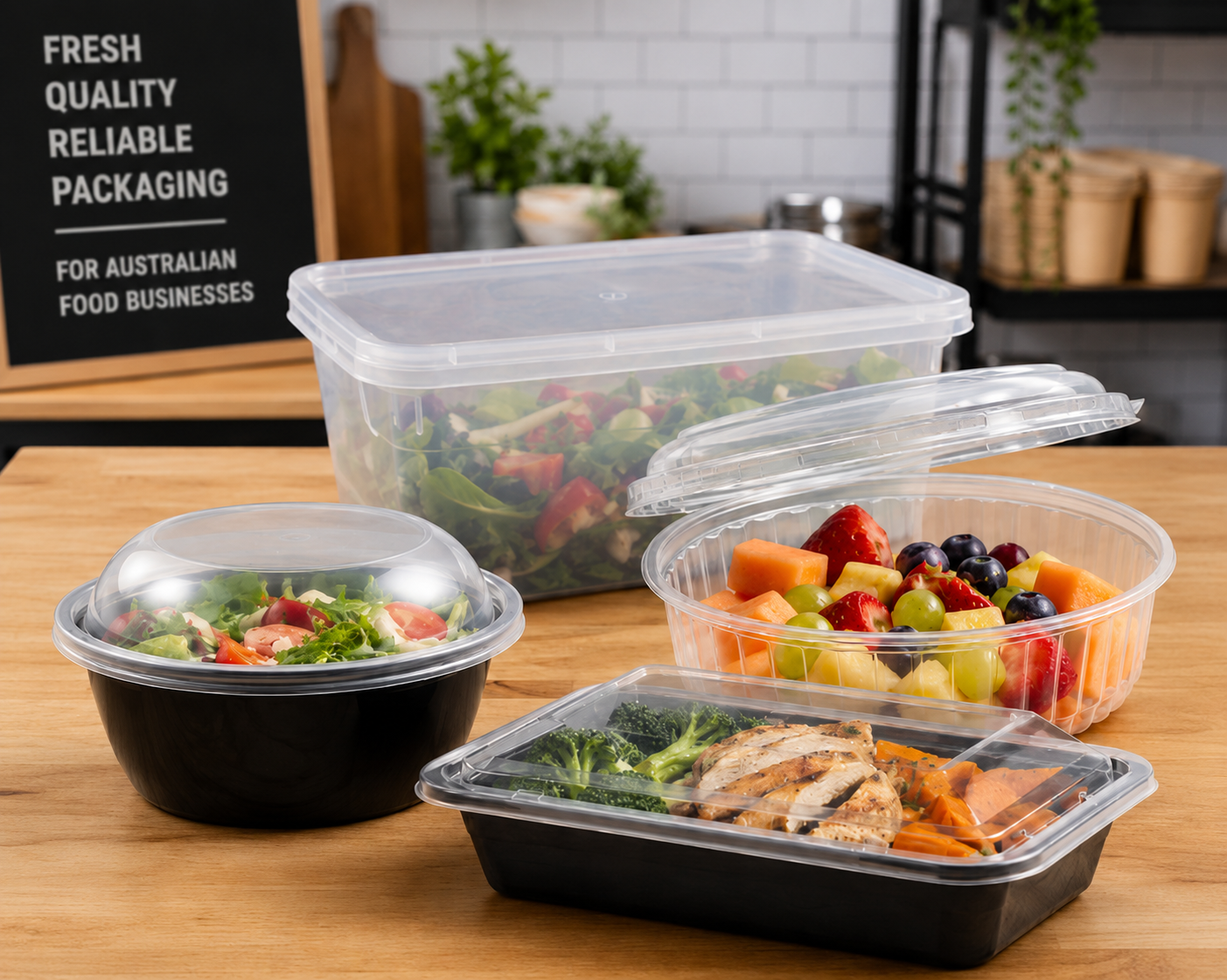
If you run a cafe, deli, salad bar or takeaway venue, you already know that packaging is never really "just packaging". The container your food goes into is often the first physical thing a customer touches after they order, and in the case of grab-and-go meals, it is frequently the reason they buy in the first place. A clear plastic container with a well-fitted lid does something that an opaque box cannot: it sells the food before the customer even opens it.
For Australian food businesses sourcing packaging in volume, clear plastic containers are one of the most versatile and cost-effective formats available. They cover everything from a 200 mL deli pot of marinated olives to a 1500 mL rectangular base loaded with a Buddha bowl. The challenge is not finding them. The challenge is choosing the right material, the right lid style and the right size for your specific use case, then buying smart so you are not overpaying per unit or running out on a Friday afternoon.
This guide cuts through the noise. We cover materials, sizes, lid types, hot versus cold food rules, food safety basics and bulk buying strategy, with practical numbers throughout. By the end, you will have a clear framework for making confident sourcing decisions.
———————————————
Key Takeaways
Clear containers increase product visibility and help drive impulse purchases at the point of sale.
PET is the standard choice for cold food and ambient display; PP is required for hot food, microwaving and freezer-to-oven use.
Sizes range from roughly 200 mL deli pots to 2000 mL catering tubs; matching volume to portion prevents waste and controls cost.
Lid style matters as much as container style: snap-on lids suit transport, hinged lids suit display, and domed lids accommodate height.
Buying in carton quantities (typically 50-500 units per carton depending on size) meaningfully reduces per-unit cost and shipping overhead.
Eco alternatives such as rPET and compostable containers are worth considering, but each involves trade-offs in cost, performance and end-of-life infrastructure.
———————————————
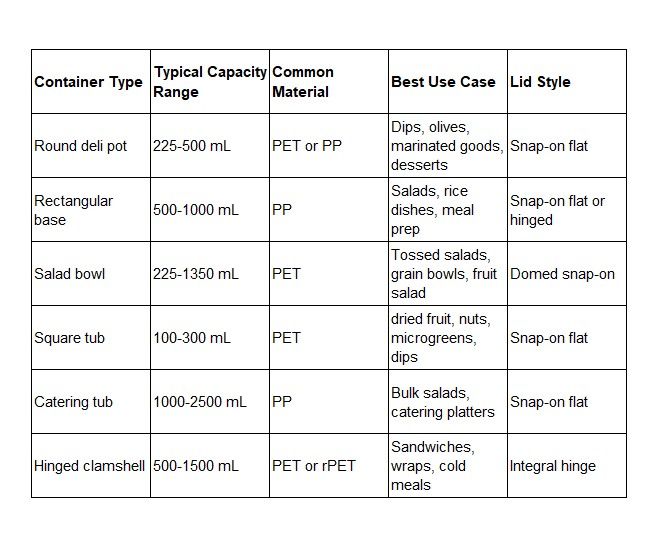
Summary Table
———————————————
Why Clear Plastic Containers Work for Food Service
The commercial case for clear containers is straightforward: customers buy what they can see. In a deli fridge, a salad bar or a grab-and-go cabinet, visibility is a direct driver of sales. When a customer can see the colour of the beetroot, the layers in a parfait or the gloss on a marinated feta, they are far more likely to pick it up than if those same foods are hidden inside a white or foil container.
This is not just intuition. Consumer research consistently shows that food presentation influences purchase decisions before taste or price becomes a factor. For hospitality operators, this means packaging that obscures food is doing active harm to your revenue, not just neutral packaging.
Beyond aesthetics, clear containers offer several practical advantages for food service operators.
Product identification at a glance. In a busy kitchen or cool room, staff can identify contents without opening containers, reading labels or checking handwriting on masking tape. This speeds up service and reduces errors, particularly during peak periods.
Hygiene and tamper evidence. A properly fitted lid on a clear container signals to customers that the food has not been touched since it was packed. Many operators use tamper-evident seals or shrink bands on top of their clear lids for added assurance, which is particularly relevant for pre-packed meals sold in retail or delivered through third-party platforms.
Brand presentation. A clear container is a neutral canvas that lets your food do the talking. Pair it with a quality printed label and you have a professional, retail-grade presentation at a modest per-unit cost.
Portion control and consistency. Standardised container sizes make portion control straightforward. Once you have established that a 750 mL rectangular base holds your standard lunch salad, every portion is consistent, which simplifies costing, pricing and staff training.
———————————————
Materials Explained: PET, PP and rPET
Not all clear plastic containers are made from the same material, and the material determines almost everything about how the container performs. The three materials you will encounter most often in the Australian food service market are PET, PP and rPET.
PET (Polyethylene Terephthalate)
PET is the most widely used material for clear food containers, and for good reason. It produces a glass-like clarity that showcases food beautifully, it is lightweight, and it has a relatively low cost per unit at scale.
PET is suitable for cold food storage and ambient display. Its practical temperature range is generally 0°C to around 60°C, though most food service applications keep it well below that upper limit. PET containers should not be used in the microwave or oven, and they are not designed for freezer-to-microwave use. If your customers are going to reheat food in the container, PET is the wrong choice.
On recyclability, PET (resin code 1) is one of the most widely accepted plastics in Australian kerbside recycling programmes. Most councils in metropolitan areas across New South Wales, Victoria, Queensland and Western Australia accept PET in their yellow-lid bins, making it a more responsible choice than some alternatives when end-of-life is a consideration.
Common PET applications in food service include salad bowls, deli pots for cold dips and marinated goods, fruit containers, cold dessert cups and hinged clamshells for sandwiches and cold meals.
PP (Polypropylene)
PP is the material you need when heat is involved. Its temperature tolerance is significantly higher than PET, with a practical range of roughly -20°C to 120°C depending on the specific formulation and wall thickness. This makes PP suitable for hot soups, curries, stews and any application where food goes in warm, or where customers will microwave the container.
The trade-off is clarity. PP containers are typically less optically clear than PET, often appearing slightly milky or translucent rather than fully transparent. For some applications this is a non-issue, particularly when the container is sold as a meal that will be microwaved at home. For a display case where visual impact is the priority, PET is generally the better choice.
PP is also freezer-safe, making it a practical option for businesses that pre-prepare and freeze meals for later sale or delivery. Resin code 5, PP is accepted in many but not all Australian council kerbside programmes, so operators should check their local council's guidance.
Common PP applications include hot soup tubs, curry and stew containers, meal prep tubs for microwave-ready meals, and any container that moves from freezer to microwave.
rPET (Recycled Polyethylene Terephthalate)
rPET is PET made from post-consumer recycled content, most commonly from recycled PET bottles and containers. It performs in largely the same temperature range as virgin PET and maintains good clarity, though very high recycled-content rPET can sometimes appear slightly less pristine than virgin PET.
From a sustainability standpoint, rPET reduces demand for virgin petroleum-derived plastic and has a lower carbon footprint per unit compared to virgin PET, though the exact figures vary by supply chain and recycled content percentage. For food service businesses under pressure from customers or corporate clients to demonstrate environmental responsibility, rPET is a credible and practical step without sacrificing the functionality of clear plastic.
rPET containers are subject to the same temperature limitations as virgin PET: cold and ambient only, no microwave or oven use.
———————————————
Sizes and Shapes: Matching Container to Use Case
Choosing the right size is not just about fitting the food. It is about portion standardisation, visual presentation, freight efficiency and cost. A container that is too large for your portion makes the food look skimpy; one that is too small creates leakage risk and frustrates customers.
Here is a practical breakdown of the most common formats and their typical food service applications.
Round Deli Pots (8oz/225 mL to 16oz/440 mL)
Round deli pots are the workhorse of the deli counter. They are compact, stackable and immediately recognisable to customers as a portion-sized product. The 200-250 mL range suits small portions of dips, taramasalata, tzatziki, marinated feta, olives or individual desserts like panna cotta or mousse. The 400-500 mL range covers larger dip servings, small side salads, coleslaw, and individual serves of rice salad or pasta salad.
Most round deli pots use a snap-on flat lid. The key fit requirement is a positive click when closed: if the lid does not click securely, liquid-based products will leak in transit.
Rectangular Bases (500 mL to 1000 mL)
Rectangular plastic containers are the standard format for salads, grain bowls, rice dishes and composed meals. Their flat base and straight sides make them easy to label, easy to stack in a cool room and efficient to pack into delivery bags. A standard 750 mL rectangular container will hold a typical single-serve lunch salad with room for dressing. The 1000mL range suits larger meals or salads with bulky toppings like croutons or nuts. Rectangular containers are available with snap-on flat lids or with snap-on domed lids for meals with height, such as a stacked grain bowl topped with microgreens.
Salad Bowls (8oz/225 mL to 48oz/1350 mL)
Salad bowls are a round or oval format designed specifically for tossed salads, fruit salads and grain bowls. The bowl shape gives a generous visual impression and the format works particularly well with domed lids, which provide clearance above the fill line without compressing salad leaves or delicate toppings. A domed lid on a salad bowl also gives the container a premium appearance in a display cabinet.
The 500-750 mL range covers a standard side salad or a light lunch. From 1000 mL upward, you are looking at a main meal portion or a generous shared side.
Square Tubs (100 mL to 300 mL)
Small square PET tubs are best suited to cold food portions, samples and dry products rather than hot meals. Common uses include dried fruit, nuts, trail mix, confectionery, microgreens, garnishes, fruit portions, cold sauces, dips and small deli items.
Because PET is designed for cold food applications, these containers should not be used for hot foods, soups, curries or microwave reheating. Their clear presentation makes them ideal for products where visibility matters, allowing customers to easily see the contents while keeping portions neatly contained.
The compact square shape also makes them easy to stack, store and merchandise in fridges, display cabinets and grab-and-go retail environments.
Catering Tubs (3000 mL)
For caterers preparing food in volume or delis selling salads and marinated goods by the kilogram, larger tubs in the 3 litre range are essential. These are typically PP for hot food preparation or PET for cold salads and antipasto. They are designed to be displayed in a refrigerated cabinet for scooped service or used in a kitchen for batch storage.
———————————————
Lid Types and Sealing: Getting the Right Fit
The lid is not an afterthought. A poorly fitted lid causes leaks, damages your brand reputation and frustrates customers. The three main lid formats each have a distinct use case.
Snap-On Flat Lids
Snap-on flat lids are the most common lid type for deli pots, rectangular bases and square tubs. They create a firm perimeter seal when pressed down correctly and they stack efficiently, which is important for storage in a commercial kitchen. Flat lids work well when the food does not extend above the container rim, such as a rice salad, a dip or a soup.
The critical fitting requirement: always order lids that are confirmed compatible with the container base you are using. Different brands and even different product lines within the same brand may not be interchangeable even if dimensions look similar. Ordering containers and lids from the same product line guarantees fit.
Domed Lids
Domed lids provide headroom above the container rim, making them ideal for salads with volume, stacked grain bowls, fruit cups topped with granola or any food where flat compression would damage the presentation. They also create a visually generous appearance that appeals in a display cabinet.
The trade-off is stackability: domed lids do not stack as efficiently as flat lids, so storage space in a cool room or display cabinet is a consideration.
Hinged Clamshell Lids
Hinged plastic containers are a single-piece format where the lid and base are connected by a living hinge, typically moulded in PET or rPET. They are fast to open and close, which suits high-volume assembly, and they eliminate the need to manage a separate lid inventory. Clamshells are particularly popular for sandwiches, wraps, cold meals and bakery items.
The limitation of clamshells is that they are not designed for liquid-containing foods: the hinge seal is not liquid-tight. For soups, dressings or marinated goods, a separate snap-on lid with a positive seal is the right choice.
———————————————
Hot vs Cold Food: Safety Basics You Cannot Ignore
Material selection and food safety are directly connected. Using the wrong container material with the wrong food temperature is not just a presentation problem. In some cases it can create a food safety risk, and in all cases it puts you at risk of a customer complaint.
The core rule is simple: PET for cold, PP for hot.
For cold food applications, PET performs well at refrigerator temperatures (1-4°C) and can handle brief ambient display. It should not be used with food above approximately 60°C, and it is not microwave-safe. If you are packing food that comes off the stove or out of a bain-marie, allow it to cool to below 60°C before placing it in a PET container, or switch to PP.
For hot food sold to customers who will reheat it at home, PP is the appropriate choice. PP containers rated as microwave-safe can typically handle repeated short microwave cycles, though customers should always be advised to remove the lid before microwaving unless the lid is also PP and explicitly rated for microwave use.
For frozen meals, PP is again the preferred material. It tolerates freezer temperatures without becoming brittle, and if the product is designed to go directly from freezer to microwave, a PP container with a PP lid is the only appropriate format.
Food safety compliance in Australia is governed by Food Standards Australia New Zealand (FSANZ) under the Australia New Zealand Food Standards Code. While FSANZ does not specify container materials per se, the general requirement is that food packaging must not contaminate the food. Using a container outside its rated temperature range is a risk to compliance, not just quality.
———————————————
Buying in Bulk: How to Estimate Quantities and Reduce Cost
Bulk buying is where the economics of disposable packaging are won or lost. A cafe buying 50 containers at a time from a local supplier is paying a significantly higher per-unit cost than a deli buying 10 cartons at a time from a packaging wholesaler. The maths is not complicated, but the planning discipline required to achieve it consistently is something many operators underestimate.
Understand Your Weekly Volume
Start with your actual usage data. If you are selling an average of 80 salads per day across a five-day week, you are using 400 salad containers per week. A standard carton might contain 200-300 units depending on container size. That means you are turning over roughly one to two cartons per week. Holding two to three weeks of stock means keeping 3-6 cartons on hand, which is a reasonable buffer without creating storage problems.
For seasonal businesses, build in a usage multiplier for your peak period. A catering company that doubles its volume in November and December should pre-order accordingly rather than scrambling for stock when suppliers are under pressure and freight times extend.
Typical Carton Quantities
As a general guide, clear plastic containers in the Australian market are typically sold in the following carton quantities:
Small deli pots (200-300 mL): 300-500 units per carton
Medium containers (500-750 mL): 200-300 units per carton
Large containers (1000-1500 mL): 100-200 units per carton
Lids (sold separately in most cases): match the container carton quantity
These are approximate figures and vary by supplier and product line. Always confirm carton quantities before placing a bulk order so your cost-per-unit calculations are accurate.
Calculate Your True Cost Per Unit
The sticker price on a carton is not your true cost. Add freight, any minimum order surcharges and the cost of carrying excess stock (which is a real cost if it creates cash flow strain or results in expired or damaged product). A supplier who offers free freight above a certain order value may represent a better total cost than a supplier with a lower product price but significant freight charges.
For most small-to-medium food businesses, placing monthly bulk orders that align with payment terms and storage capacity is a practical strategy. Larger operations with dedicated dry storage and reliable cash flow can order quarterly to maximise per-unit savings.
Standardise Your Container Range
One of the most effective cost-reduction strategies is also one of the simplest: reduce the number of different container sizes and formats you stock. Every additional size or format you carry requires its own safety stock buffer, creates its own reorder point and adds complexity to your ordering process. If you can serve your entire menu with three container sizes and two lid types, you will spend less on packaging per year than an operator running eight different formats, even if the per-unit price is identical.
Review your menu with this lens. Ask which container sizes genuinely require a different format and which could be consolidated without affecting portion presentation.
Reducing Stockouts
Running out of containers during service is an operational failure that costs you sales and damages staff morale. A simple reorder trigger system prevents most stockouts: set a minimum stock level for each container type, visible on your storeroom shelf or in your inventory system, and place a new order when stock hits that trigger point. The trigger should give you enough runway to receive a new delivery before you hit zero, accounting for your supplier's lead time.
For most Australian businesses ordering from domestic packaging wholesalers, lead times of two to five business days are typical for stock items. If you are ordering custom-printed or non-standard containers, build in significantly more lead time.
———————————————
Clear Plastic vs Eco Alternatives: A Balanced View
The conversation about sustainable packaging is real and ongoing in Australian food service. State governments and local councils have been progressively introducing single-use plastic regulations, and customer expectations around packaging are shifting, particularly among younger demographics in metropolitan markets.
For businesses weighing clear plastic containers against eco alternatives, here is a balanced summary of the main options.
rPET: The Pragmatic Step
rPET containers perform essentially identically to virgin PET in cold food applications. They carry a lower environmental footprint in production and support the circular economy by creating demand for collected and processed PET. For businesses that want to make a genuine improvement without changing their operations or accepting higher costs, rPET is the most straightforward option.
The caveat: rPET is only environmentally beneficial if the container is actually recycled at end of life. If your containers go into general waste, the benefit is reduced significantly.
Compostable and Plant-Based Containers
Certified compostable containers, including those made from sugarcane bagasse, PLA (polylactic acid) derived from corn starch or other plant-based materials, are increasingly available in Australia. They perform well in specific use cases: bagasse is excellent for hot foods and handles microwave use in many formulations; PLA-based clear containers offer reasonable clarity for cold applications.
The important qualification is that most certified compostable containers require industrial composting infrastructure to break down properly. In a home compost bin or a standard landfill, they do not decompose significantly faster than conventional plastic. Unless your business has access to an industrial composting service or you are operating in a venue with a managed food waste programme, the end-of-life claim for compostable containers needs honest scrutiny.
Cost is also a factor. Compostable containers generally carry a higher per-unit cost than equivalent PET or PP containers, typically ranging from 20% to over 100% more depending on the format and volume. For a high-volume takeaway operation running on thin margins, this is a real consideration.
The Honest Assessment
The most responsible packaging choice depends on your specific situation: your menu, your customer base, your end-of-life options and your cost structure. For businesses where cold food presentation is the priority and recyclable packaging is valued, PET or rPET is the right choice. For hot food, PP remains the functional standard. For businesses with genuine composting infrastructure and customers who prioritise sustainability as a differentiator, certified compostable formats are worth the additional cost.
What does not help anyone is greenwashing: claiming a container is eco-friendly based on its label without understanding what happens to it after it leaves your venue. Make the choice that is honest and appropriate for your operation, and communicate it clearly to your customers.
———————————————
FAQs
What is the difference between PET and PP clear plastic containers?
PET (polyethylene terephthalate) offers superior clarity and is ideal for cold food display at temperatures from refrigeration up to around 60°C. It is not microwave-safe. PP (polypropylene) is less optically clear but tolerates a much wider temperature range, roughly -20°C to 120°C, making it suitable for hot food, microwave use and freezer-to-microwave applications. Choose PET for cold presentation and PP for hot or reheatable meals.
Can I use clear plastic containers in the microwave?
Only if the container is made from PP and is explicitly labelled as microwave-safe. PET containers should never be microwaved. When in doubt, check the resin identification code on the base of the container: code 1 is PET (not microwave-safe), code 5 is PP (microwave-safe if labelled accordingly). Always advise customers to remove the lid before microwaving unless the lid is also rated for microwave use.
What size clear container do I need for a standard lunch salad?
A 750-850 mL rectangular container or salad bowl is the most common size for a standard single-serve lunch salad in Australian food service. If your salads include bulky toppings such as croutons, nuts or thick protein portions, consider a 1000 mL container with a domed lid to prevent compression and maintain presentation.
How many containers come in a bulk carton?
Carton quantities vary by container size and supplier. As a general guide: small deli pots (200-300 mL) typically come in cartons of 300-500 units; medium containers (500-750 mL) in cartons of 200-300 units; and large containers (1000-1500 mL) in cartons of 100-200 units. Lids are usually sold separately in matching quantities. Always confirm carton quantities with your supplier before ordering to calculate accurate per-unit costs.
Are clear plastic containers recyclable in Australia?
PET containers (resin code 1) are among the most widely accepted plastics in Australian kerbside recycling programmes and are accepted in the yellow-lid bin in most metropolitan council areas. PP containers (resin code 5) are accepted by many but not all councils. rPET containers follow the same recycling pathway as virgin PET. Acceptance varies by region, so it is worth directing customers to check with their local council or the ARL (Australasian Recycling Label) programme for guidance.
What lid type should I use for delivery and takeaway orders?
For delivery, a secure snap-on flat lid with a positive click seal is the most reliable choice. It minimises leakage risk during transit and stacks efficiently in delivery bags. For meals with height such as grain bowls or stacked salads, a snap-on domed lid provides necessary clearance without compressing the food. Hinged clamshells are convenient for sandwiches and cold items but are not suitable for liquid-containing foods.
How do I estimate how many containers to order for my business?
Calculate your average daily usage per container type, multiply by seven for weekly volume, then multiply by the number of weeks of stock you want to hold (two to four weeks is a practical buffer for most businesses). Divide that total by the carton quantity to determine how many cartons to order. Adjust upward for peak trading periods and account for your supplier's typical lead time when setting your reorder trigger point.
What is the best clear container for a deli counter display?
For a refrigerated deli display, PET round deli pots with snap-on flat lids are the standard choice for dips, marinated goods and antipasto items up to about 500 mL. For larger salads displayed for scooped service, PET or rPET rectangular containers or catering tubs in the 1-2 litre range work well. The clarity of PET glass-like walls showcases the colour and texture of your products far more effectively than PP or opaque alternatives.
———————————————
References
Food Standards Australia New Zealand (FSANZ). Australia New Zealand Food Standards Code. https://www.foodstandards.gov.au/food-standards/food-standards-code
Australasian Recycling Label (ARL) Programme. How the ARL Works. https://recyclingnearyou.com.au/arl/