Get exclusive offers, new product updates & helpful resources straight to your inbox.
By subscribing, you agree to our Privacy Policy and consent to receive updates from our company.
//
Certified Compostable Packaging: AS 4736, AS 5810 Guide
Latest News & Updates
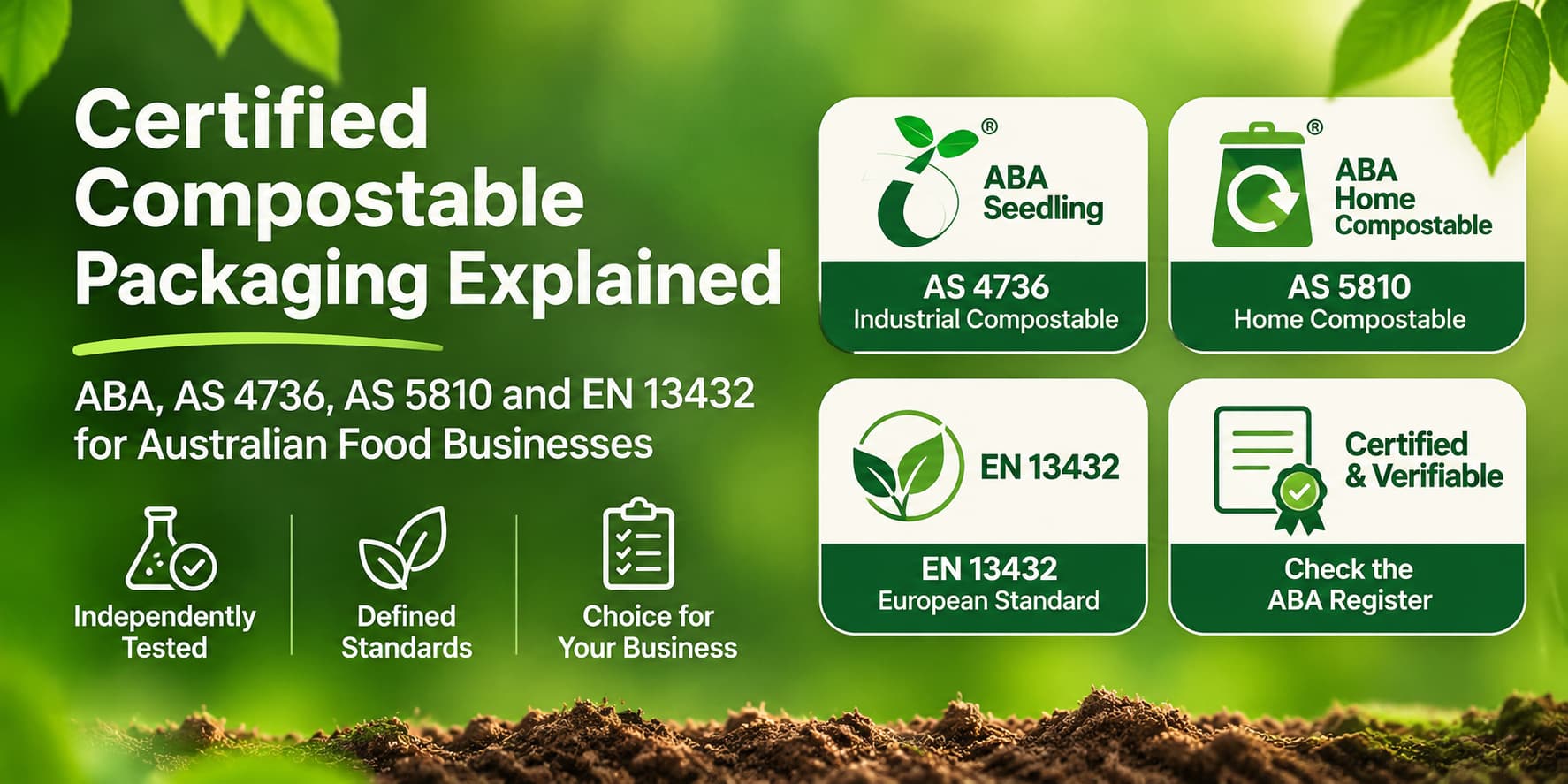
Certified Compostable Packaging Explained: ABA, AS 4736, AS 5810 and EN 13432 for Australian Food Businesses
24 November 2026
Certified compostable packaging has been independently tested against a recognised standard, such as AS 4736 for industrial composting, AS 5810 for home composting or EN 13432 in Europe, and carries a verifiable certificate. In Australia, look for the ABA Seedling or Home Compostable logo with a certificate number you can check on the ABA register.
Most cafe and takeaway owners have seen packaging labelled 'eco', 'biodegradable' or 'compostable' and wondered which claims actually hold up. The honest answer is that many do not. Words on a box cost nothing. A certificate number that traces back to a test report is the only claim you can verify.
This guide shows you how to read the logos, what the Australian and European standards test, how to look up a certificate, and how to match packaging to the disposal options your customers really have. It finishes with a supplier checklist you can use before any bulk order.
Key Takeaways
'Biodegradable' has no time limit and no test behind it. 'Certified compostable' means a product passed defined tests for biodegradation, disintegration, ecotoxicity and heavy metals.
AS 4736-2006 covers industrial composting. AS 5810-2010 covers home composting. They are separate certifications, and one does not automatically imply the other.
The Australasian Bioplastics Association (ABA) runs the local certification scheme. Its Seedling logo marks industrial compostability and its Home Compostable logo marks AS 5810.
EN 13432 is very close to AS 4736 in its core criteria, but an overseas certificate alone does not prove local acceptance by your council or composter.
Certification is only useful if a composting pathway exists. Check your council's FOGO rules and your commercial waste contractor before you choose.
Verify the finished product, including lids, linings and labels, not just the base material.
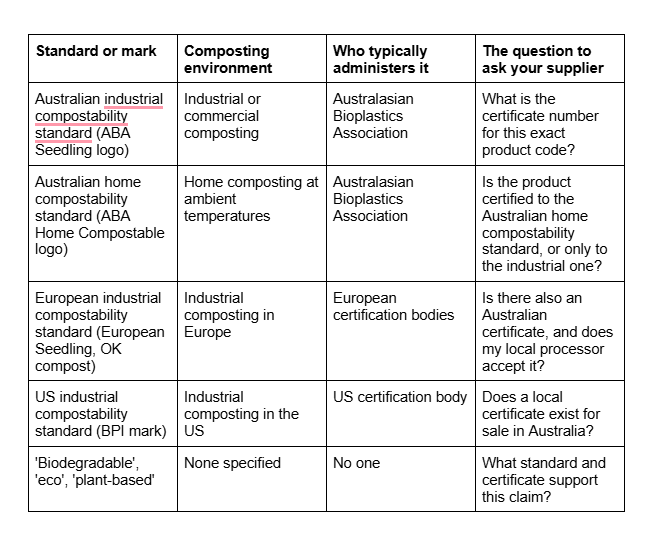
Summary Table
Why does certification matter for compostable packaging?
Certification matters because 'compostable' and 'biodegradable' are not the same thing, and only compostable claims backed by a standard can be verified. Without a certificate, you carry the risk if the claim is wrong: customers lose trust, councils reject the waste, and the ACCC can treat unsupported environmental claims as misleading.
Why 'biodegradable' tells you almost nothing
Nearly everything biodegrades eventually. A plastic bag may break down over decades, a timber chair over a lifetime. 'Biodegradable' sets no time frame, no environment and no end result. It does not say the material leaves behind safe compost instead of fragments.
That gap is why unverified 'biodegradable' cups and containers cause trouble. They can look green on the shelf yet be rejected by every composter in your area. Oxo-degradable plastics are the worst case. They fragment into smaller pieces rather than being fully consumed by microbes, and they do not meet compostability standards.
A compostable claim is different because it is tied to a test method. The product must break down in a defined environment, within a defined time, without harming the finished compost.
The ACCC and your own legal exposure
The ACCC has made environmental and sustainability claims an enforcement priority. Its guidance for business, available on the ACCC website, sets out the principles it applies. Claims should be accurate, backed by evidence, clear about their limits, and written in plain language.
This applies to you as well as your supplier. If you print 'compostable' on your cup sleeve or menu, or tell customers your packaging is eco-friendly, the claim becomes yours under the Australian Consumer Law. 'My supplier told me' is a weak defence if you never asked for evidence. A certificate number on file is your evidence.
The National Packaging Targets
Australia's National Packaging Targets, coordinated by APCO, set the direction for the industry. They include the goal that all packaging be reusable, recyclable or compostable, and they target phasing out problematic and unnecessary single-use plastics. The 2025 target date has now passed, and the policy focus has moved towards stronger design and labelling expectations.
The key point for food businesses is that 'compostable' only counts if the packaging actually gets composted. Certification proves the product can compost. It does not prove it will. We come back to that gap later in this guide.
What do AS 4736 and AS 5810 actually test?
AS 4736-2006 covers biodegradable plastics suitable for industrial composting. AS 5810-2010 covers those suitable for home composting. Both test four things: biodegradation, disintegration, ecotoxicity and heavy metals. The main difference is temperature and time. Industrial composting runs hot and fast, while home composting runs cooler and slower.
Both standards are published by Standards Australia. The summary below reflects the standards as described by the ABA and equivalent European criteria. Always confirm exact figures against the current standard text, because it is the only authoritative source.
The four tests behind a compostable certificate
1. Biodegradation. This asks whether microbes actually consume the material and convert it to carbon dioxide, water and biomass. Under AS 4736, the product must reach at least 90% biodegradation, measured against the theoretical maximum or a reference material, within 180 days under controlled composting conditions at about 58°C.
2. Disintegration. This asks whether the item physically falls apart. In the industrial test, no more than 10% of the original dry mass may remain in fragments larger than 2 mm after 12 weeks. A product can break into pieces without biodegrading, which is why both tests are needed.
3. Ecotoxicity. The finished compost is tested to confirm it does not harm plant growth. Seeds are grown in compost containing the test material and compared with a control. If the packaging leaves residues that stunt plants, it fails.
4. Heavy metals and hazardous substances. The standard sets limits on regulated metals and other substances in the material. This stops pigments, inks, additives or coatings from adding contaminants to compost.
A product must pass all four. A cup that disintegrates beautifully but leaves toxic residue fails. So does one that biodegrades slowly but passes the sieve test.
How AS 5810 differs for home composting
Home compost heaps are cooler, smaller and less consistent than commercial windrows. AS 5810-2010 therefore tests at ambient temperatures, roughly 20-30°C, and allows more time. As described by the ABA, the biodegradation threshold remains 90%, but the period extends to about 12 months, and disintegration is assessed over about six months.
The ecotoxicity and heavy metals requirements follow the same logic as AS 4736. The practical result is a tougher material test for a less demanding disposal environment. Fewer products hold the Home Compostable logo than the Seedling logo, and that is by design.
Certification applies to a specific product
Thickness, formulation, coatings, inks and additives all affect test results. A certificate typically covers a defined product or material at a defined thickness, not an entire material family. A thin film may pass where a thicker one of the same polymer does not. This is why 'made from certified material' and 'certified product' are not the same claim.
What is the ABA and how does the Seedling logo work?
The Australasian Bioplastics Association (ABA) runs the local certification scheme that verifies products against AS 4736 and AS 5810. Its Seedling logo marks industrial compostability, and its Home Compostable logo marks AS 5810 compliance. Each licensed product carries a certificate number that you can check against the ABA's list of certified products.
The ABA is an industry association for bioplastics in Australia and New Zealand. Its certification role matters because it gives the market a shared, recognisable mark. Councils, composters and brand owners know what the Seedling logo is meant to represent. A made-up leaf icon or green tick carries no such weight.
Seedling logo versus Home Compostable logo
The Seedling logo indicates the product is certified to AS 4736 for industrial composting. It should only go into commercial composting systems that accept it, which usually means a commercial organics collection or a FOGO system with a processor that takes certified packaging.
The Home Compostable logo indicates certification to AS 5810. These products are designed to break down in a well-managed home compost. Treat it as a separate certification. If a supplier says a product is 'home compostable', ask for the AS 5810 certificate specifically.
A product can carry one logo or both, depending on what it was tested for. Do not assume one implies the other.
How to look up an ABA certificate number
The ABA lists certified products and licence holders on its website at bioplastics.org.au. Layouts change, so follow the principle rather than a fixed click path:
Get the certificate or licence number from the pack or from your supplier in writing.
Search the ABA's certified product list by company name, product name or number.
Confirm the licence holder matches the manufacturer or brand you are buying from.
Check the product description, and compare it to the item code on your quote or invoice.
Confirm which standard applies (AS 4736, AS 5810 or both) and that the certificate is current.
Save a screenshot or PDF for your compliance file.
If the number does not appear, ask the supplier to explain. There may be a simple answer, such as a recent renewal or a different licence holder. But if they cannot, treat the logo as unverified.
A logo without a number is a red flag. Logos are licensed marks, and a legitimate certificate always has an identifier behind it.
How does EN 13432 compare with AS 4736?
EN 13432 is the European standard for packaging recoverable through composting. Its core criteria are very close to AS 4736: 90% biodegradation within six months and disintegration within 12 weeks. A European certificate shows a product passed those tests, but it does not prove the product suits Australian processors or carries ABA certification.
EN 13432 is published by the European Committee for Standardization (CEN). It tests the same four areas as AS 4736: biodegradation, disintegration, ecotoxicity and heavy metals. For a buyer, the science overlaps heavily. The differences lie elsewhere.
Other international marks you will see
Imported packaging often carries one of these:
European Seedling logo. The Seedling mark originated in Europe and is based on EN 13432. The Australian Seedling logo is used under the ABA scheme.
OK compost INDUSTRIAL and OK compost HOME. Marks issued by European certification bodies. They are widely recognised overseas.
BPI. A US certification mark based on ASTM D6400.
All three signal that testing took place. None confirms that the product has been checked under the Australian scheme.
Why an overseas certificate alone may not be enough
There are four practical reasons to ask for more than a European certificate.
Local recognition. Australian councils and composters tend to reference AS 4736 and the ABA scheme. A processor reviewing contamination rules is far more likely to recognise a Seedling logo with an ABA number.
Product match. European certificates often cover a specific factory, thickness or formulation. The version imported into Australia may be a different one.
Composting conditions. Australian facilities vary in process, size and feedstock. Acceptance is decided by the facility and council, not by a certificate alone.
Paper trail. If a regulator or customer questions your claim, an Australian certificate that traces to a local scheme is easier to defend.
This does not make EN 13432 products bad. It means you should ask whether a local certificate exists, and whether your composter accepts the product.
What is the difference between industrial and home compostable in practice?
Industrial compostable packaging only breaks down properly if it reaches a commercial composting facility that accepts it. Home compostable packaging suits backyard bins but is rarely collected. For most Australian food businesses, the deciding factor is not the logo but which bin your customers and your council will actually take.
FOGO rules vary by council
FOGO (food organics and garden organics) collection is run by councils, and the rules differ across the country. Some councils accept only food scraps and garden waste. Some accept certified compostable caddy liners. A few accept certain certified food packaging. Many accept no packaging at all.
The processor behind your council's service sets the real limits. Their concern is contamination. Look-alike products that do not break down, or leave residues, can downgrade a whole batch of compost. That is why many operators prefer a simple rule such as 'certified only' or 'no packaging'.
The only reliable approach is to ask. Check your council's FOGO guidelines, and if you operate a commercial business, call your waste contractor. Ask whether they accept AS 4736-certified packaging, whether it must carry the Seedling logo, and whether items like cups and lids are included.
Commercial composting access
Businesses often have better options than households. Commercial organics collection services may take food-contaminated packaging from dine-in venues, events and food courts. These controlled settings work best for certified compostable items, because the waste stream is managed and staff can sort it.
Takeaway is the harder case. Once a cup leaves your premises, you lose control of where it goes. Many compostable takeaway items end up in general waste. In landfill, a compostable product does not deliver the benefit you paid for.
A scenario: the cafe whose cups were turned away
Imagine a cafe that switches to cups labelled 'biodegradable' because the supplier's brochure called them eco-friendly. There is no certificate number and no ABA logo. The owner assumes the cups can go in the FOGO bin, tells staff to collect them with the food scraps, and puts 'compostable' on the menu board.
A few weeks later, the council bin inspector flags contamination. The council only accepts certified compostable items, and the cups are not certified. The bin is rejected, the cafe reverts to general waste, and the menu claim is now one the owner cannot support.
The cups cost more than standard ones, delivered no environmental benefit, and created a marketing risk. A five-minute certificate check, plus one call to the council, would have prevented all of it.
What to tell customers about disposal
Keep the message short and honest. Something like this works:
'Certified compostable (AS 4736). Please place in a commercial compost or FOGO bin only if your council accepts it. If unsure, use general waste.'
For dine-in: 'Please place in the green organics bin.' Only say this if your commercial collection accepts it.
Avoid telling customers to put compostable items in the recycling bin. Avoid 'home compostable' unless the product holds an AS 5810 certificate. Never imply that landfill disposal is fine because the item is 'natural'.
Matching the product to your range
Material still matters, and our Sugarcane vs PLA vs Paper guide explains how those materials differ in performance, heat tolerance and cost. Our Compostable Takeaway Containers guide covers format choices. This article is the verification layer on top: whichever material you pick, the certificate is what proves the claim.
If you are ready to shop, browse the eco and sugarcane bagasse range at Food Packaging Online. Check the certification details on each product listing, and contact the team for documentation before you place a bulk order. That includes bagasse containers, eco and aqueous coffee cups, and compostable paper containers.
Why certification is a disposal decision, not a purchasing badge
Most buying guides treat a compostable certificate as the finish line. In my view, it is the starting point. A certificate answers one question: can this product compost under test conditions? It says nothing about whether your customers have a bin that leads to a composter.
So my advice to food business owners is to work backwards. Start with disposal, then choose certification.
Dine-in with a commercial organics collection. Industrial compostable (AS 4736, Seedling logo) is the strongest fit. You control the bin, the staff and the contractor.
Takeaway in a council area with FOGO that accepts certified packaging. Industrial compostable works, but you need clear on-pack instructions and honest customer messaging.
Takeaway in an area with no organics collection. Compostable packaging may deliver little real benefit. Be careful with environmental claims, and consider whether a recyclable or reusable option fits better.
Home compostable claims. Use them sparingly. Few customers compost takeaway packaging at home, and the claim is only true if the product holds AS 5810 certification.
The second shift is to treat the certificate as a procurement record. Hold it the way you would hold a food safety certificate or a public liability policy. It protects you when a customer, council officer or competitor questions your claim.
The third is to be willing to say 'it depends' on your packaging. Customers trust a cafe that says 'compostable where accepted, check your local council' far more than one that makes a blanket green claim it cannot back up. That honesty is also the safest position under the ACCC's guidance.
FAQs
What is the difference between compostable and biodegradable packaging in Australia?
Biodegradable means a material can be broken down by microbes eventually, with no time limit, environment or standard attached. Compostable means it passed defined tests, such as AS 4736 or AS 5810, for biodegradation, disintegration, ecotoxicity and heavy metals. Only compostable claims backed by a certificate can be verified.
Is AS 4736 the same as EN 13432?
No, but they are similar. Both test biodegradation, disintegration, ecotoxicity and heavy metals under industrial composting conditions, with comparable thresholds. AS 4736 is the Australian standard used under the ABA scheme, and EN 13432 is the European standard. A European certificate does not automatically mean local certification or acceptance.
What does the ABA Seedling logo mean?
The ABA Seedling logo shows that a product has been certified under the Australasian Bioplastics Association scheme as compostable in industrial or commercial composting, in line with AS 4736. It should carry a certificate number that you can check on the ABA's list of certified products.
Can I put certified compostable packaging in my FOGO bin?
Only if your council and its processor accept it. FOGO rules vary. Some councils accept certified compostable liners or packaging, and others accept food and garden waste only. Check your council's guidelines, and for a business, ask your waste contractor before you tell customers to use the bin.
Is home compostable packaging better than industrial compostable?
Not automatically. Home compostable (AS 5810) is a separate certification for cooler, slower conditions, and it suits customers who actually compost at home. Industrial compostable (AS 4736) suits commercial collections. The better choice is the one that matches the disposal option your customers really have.
How do I check if a compostable certificate is genuine?
Ask the supplier for the certificate number and a copy of the certificate. Search the ABA's list of certified products for the number, confirm the licence holder and product match what you are buying, and check the standard and validity. If the number cannot be found, ask the supplier to explain before ordering.